DE KLOMPENDANS
The Clog dance/ Holzshuhtanz
The Clog dance/ Holzshuhtanz
You can find this delightful video on the DVD Walzertraum / Love around
the world. This DVD is hard to find in the US but well worth looking for.
De klompendans is Dutch, the Clog dance is English and the
Holzshuhtanz is German for the same piece of music
This music is a waltz, perhaps not like the type Johan Strauss has
composed.
This one has a joyful melody. It has a typical rhythm of the clogs on the
foreground. This melody is easy to remember.
Which orchestra can play this music better than the JSO.
Right! No other! Why? Because of it must be played in Holland and
executed by people we know, the beloved girls and man from the Johan
Strauss Orchestra it self.
We know that they are competent musicians coming from all over the
world.
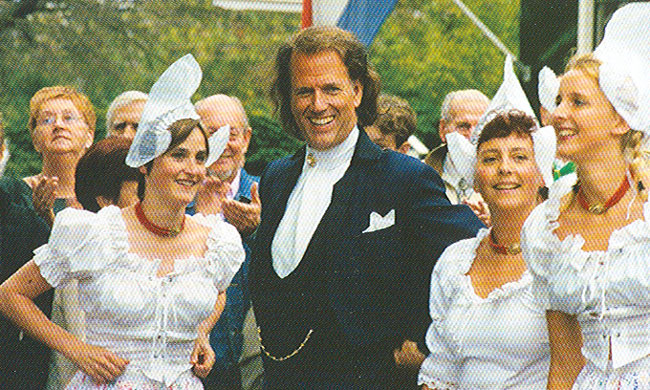
But anyhow they look great in their Volendam’s folklore dresses. Isn’t it
true?
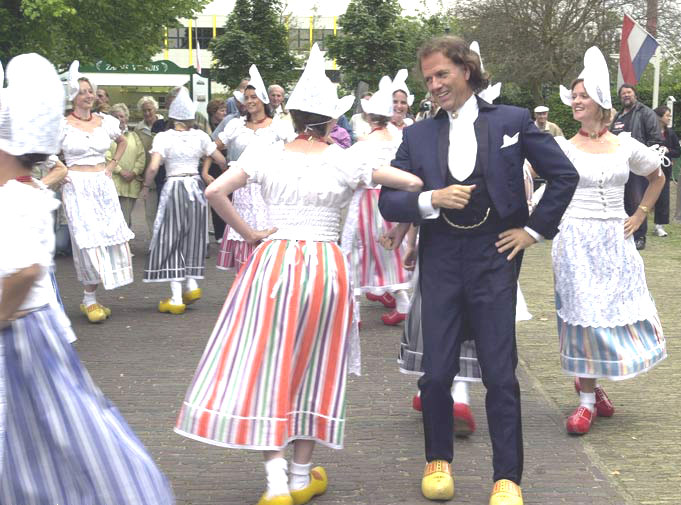
On the other hand André has rehearsed this piece so good, that the
dance movements look natural and it radiates fun and entertainment.
You can observe at André’s smiling face, that he likes to dance with
them.
You see the dance was taped at several locations in Holland. You see,
Amsterdam, Zaandam, on a fisherman’s boat with the windmills and
other typical places.
The music is not interrupted during the change of locations.
When it ends you are waking up at the concert Hal of a luxury cruise
ship. Not bat at all. Poor André every girl throw her clogs towards him,
and we know clogs are not so soft.
I am sure you will watch this clip many times. It is so charming and
everyone is at his best.
Clogs
The clogs were used in the past for a person who has to do heavy
work, like farmers, fishermen, work in slaughter houses etcetera.
Even till 1947 in some places for example children went to school
wearing clogs.
The lifetime of a clog is at least 3 months. In the past many clogmakers
exist, but today only a few craftsmen remain. The clogs are made of
poplar or willow wood. The clogmaker has to make the shape inside the
clog comfortable for the feet of the user, otherwise he looses his
customers. The clogs are used with woolen socks.
There are a few factories today with expensive machines which are
able to copy a model clog exactly into a complete pair of clogs. The
machine has sensor pins which touch the shape of the turning model
clog and make a copy of this one, and, a mirror copy. In this way a
complete pair of clogs is made.
The conclusion is that if the model clog is good, all of the copies are
good.
These factories can produce three million pairs of clogs a year.
Today most of the clogs are for sale as souvenirs for tourists.
Clog dancing
This clog dance is a traditional dance from Holland and can only be
done in groups.
The clog dance is developed early in the twenty century.
It does not exist for centuries as some people think.
Inherent to clogs, they make a lot of noise and that’s the reason that it
couldn’t be used on dance floors.
Dancing with clogs is not so easy, because clogs are not fit for dancing.
The music however is joyfully when all the clogs are at the same rhythm.
A proper training is necessary.
Dutch Folklore dressings
The traditional folklore in Holland is mainly based on dark cloth blue or
black with stripes.
There are also colorful folklore dresses in some villages.
On the head the women wear a cap, mostly white, with sometimes
golden plates at the ear side.
Each village has his own folklore costumes and hair caps.
André Rieu and the ladies of his orchestra were wearing the kind of
dresses used in Volendam.
The clogs were used in the past for a person who has to do heavy
work, like farmers, fishermen, work in slaughter houses etcetera.
Even till 1947 in some places for example children went to school
wearing clogs.
The lifetime of a clog is at least 3 months. In the past many clogmakers
exist, but today only a few craftsmen remain. The clogs are made of
poplar or willow wood. The clogmaker has to make the shape inside the
clog comfortable for the feet of the user, otherwise he looses his
customers. The clogs are used with woolen socks.
There are a few factories today with expensive machines which are
able to copy a model clog exactly into a complete pair of clogs. The
machine has sensor pins which touch the shape of the turning model
clog and make a copy of this one, and, a mirror copy. In this way a
complete pair of clogs is made.
The conclusion is that if the model clog is good, all of the copies are
good.
These factories can produce three million pairs of clogs a year.
Today most of the clogs are for sale as souvenirs for tourists.
Clog dancing
This clog dance is a traditional dance from Holland and can only be
done in groups.
The clog dance is developed early in the twenty century.
It does not exist for centuries as some people think.
Inherent to clogs, they make a lot of noise and that’s the reason that it
couldn’t be used on dance floors.
Dancing with clogs is not so easy, because clogs are not fit for dancing.
The music however is joyfully when all the clogs are at the same rhythm.
A proper training is necessary.
Dutch Folklore dressings
The traditional folklore in Holland is mainly based on dark cloth blue or
black with stripes.
There are also colorful folklore dresses in some villages.
On the head the women wear a cap, mostly white, with sometimes
golden plates at the ear side.
Each village has his own folklore costumes and hair caps.
André Rieu and the ladies of his orchestra were wearing the kind of
dresses used in Volendam.